Course Description
About the Course
Abhijith Electronic Solution offers practical, industry-oriented training in Robotics and Industrial Automation for engineering students, polytechnic students, graduates, and aspiring robotics engineers.
This course introduces learners to robotic systems, electronic hardware, sensors, actuators, motor control, embedded programming, and automation principles. Participants will learn how to integrate hardware and software to develop robots capable of sensing their surroundings, making basic control decisions, and performing specific tasks.
Through hands-on laboratory sessions and guided projects, learners will gain experience in robot assembly, circuit interfacing, motor driver configuration, microcontroller programming, and system testing.
Key Learning Outcomes
- Understand robotics and industrial automation fundamentals.
- Identify and interface sensors and actuators.
- Control DC motors, servo motors, and stepper motors.
- Program microcontrollers for robotic applications.
- Develop obstacle-avoiding and line-following robots.
- Understand feedback control and motion control fundamentals.
- Explore industrial automation, PLCs, and robotic applications.
- Build and demonstrate a functional robotics project.
Why Choose Abhijith Electronic Solution?
- Hands-on robotics development.
- Practical electronics and embedded programming.
- Industry-oriented automation concepts.
- Guided mini-projects and troubleshooting exercises.
- Technical documentation and project presentation.
- Customized college workshops and corporate training.
Who Can Join?
Engineering students, polytechnic students, graduates, and beginners interested in robotics, automation, embedded systems, and mechatronics.
What You'll Learn
Module 1: Introduction to Robotics
- Fundamentals and history of robotics.
- Types of robots and robotic applications.
- Robot components and system architecture.
- Introduction to degrees of freedom.
- Robotics in manufacturing, healthcare, and agriculture.
Module 2: Robotics Electronics
- Voltage, current, and power fundamentals.
- Sensors, actuators, and electronic interfaces.
- Motor drivers and switching circuits.
- Power supplies and battery management.
- Circuit protection and troubleshooting.
Module 3: Sensors and Signal Processing
- IR and line-tracking sensors.
- Ultrasonic distance sensors.
- Encoders and position sensors.
- Limit switches and proximity sensors.
- Sensor calibration and data acquisition.
Module 4: Motors and Motion Control
- DC motor control.
- Servo motor interfacing.
- Stepper motor fundamentals.
- H-bridge motor drivers.
- PWM-based speed control.
- Direction, position, and speed control.
Module 5: Microcontroller Programming
- Arduino and ESP32 development platforms.
- Digital and analog input/output.
- Embedded C/C++ programming fundamentals.
- Sensor integration and motor control.
- Interrupts and basic feedback control.
Module 6: Robotics Control Systems
- Open-loop and closed-loop control.
- Feedback systems and control fundamentals.
- Basic PID control concepts.
- Robot movement and navigation.
- Wireless control using Bluetooth or Wi-Fi.
Module 7: Industrial Automation Fundamentals
- Introduction to PLCs and industrial controllers.
- Ladder logic fundamentals.
- Industrial sensors and actuators.
- Relays, contactors, and motor control.
- HMI and SCADA fundamentals.
- Industrial safety and automation applications.
Module 8: Hands-on Robotics Projects
- Line-following robot.
- Obstacle-avoiding robot.
- Bluetooth-controlled mobile robot.
- Sensor-based automated system.
- Introduction to robotic arm control.
- Final project demonstration and technical documentation.
Requirements
- - Laptop or desktop computer.
- - Robotics development board, such as Arduino or ESP32.
- - Suitable motor driver module and motors.
- - Sensors, jumper wires, and prototyping components.
- - Battery or regulated power supply appropriate for the hardware.
- - Access to the required programming IDE and project tools.
- - Willingness to participate in hands-on assembly, testing, and debugging.
Prerequisites
- - Basic computer knowledge.
- - Basic electronics knowledge is beneficial.
- - Basic programming experience is helpful but not mandatory for beginner-level batches.
- - No previous robotics experience is required.
- - Suitable for engineering students, polytechnic students, graduates, and robotics enthusiasts.
Student Reviews & Feedback
Verified reviews submitted by students who attended this course.
No Student Reviews Yet for This Course
Verified reviews from enrolled students will appear here in real time.
Share This Course
Related Courses
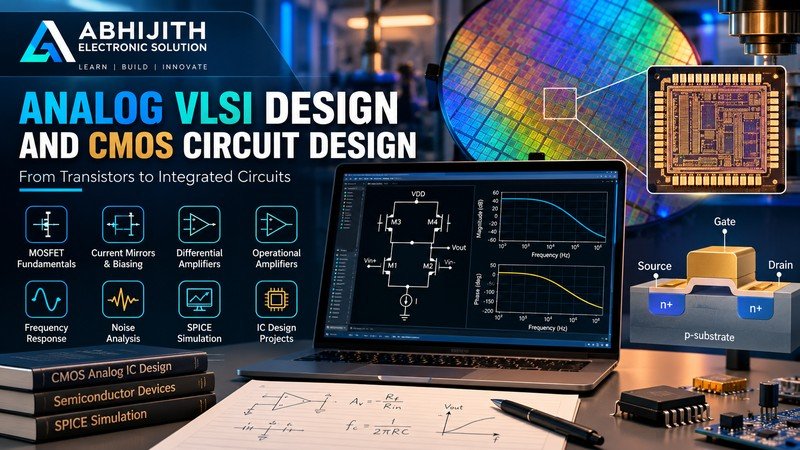
Analog VLSI Design and CMOS Circuit Design
Learn CMOS transistor fundamentals, analog integrated circuit design, current mi...
30 days
20 seats left
View Details

Machine Learning and Artificial Intelligence with Python
Learn Python programming, data preprocessing, supervised and unsupervised learni...
30 days
20 seats left
View Details
Robotics & Autonomous Vehicle Prototyping
Practical robotics course covering chassis dynamics, motor drivers, sensor fusio...
30 days
15 seats left
View Details