Course Description
About the Internship
The VLSI Design & Semiconductor Technology Internship at Abhijith Electronic Solution is designed to help students develop practical knowledge of digital circuit design, hardware description languages, and integrated circuit design fundamentals.
Very Large Scale Integration (VLSI) is a key technology used to integrate millions or billions of transistors into a single semiconductor chip. It plays an important role in processors, memory devices, automotive electronics, communication systems, and modern electronic products.
This internship introduces participants to the fundamental concepts and practical workflows involved in digital IC design, from logic design and RTL coding to simulation and functional verification.
What You Will Learn
- Digital electronics and logic circuit design.
- Semiconductor and CMOS technology fundamentals.
- Verilog HDL programming.
- Combinational and sequential circuit design.
- RTL coding and design methodology.
- Testbench development and functional simulation.
- Waveform analysis and debugging.
- Finite State Machine (FSM) design.
- Introduction to synthesis and static timing analysis.
- Basics of ASIC and FPGA design workflows.
Hands-on Practical Training
Participants will develop and simulate digital circuits such as adders, multiplexers, counters, shift registers, and finite state machines using suitable HDL simulation tools.
The internship will also introduce students to the VLSI design flow and the importance of functional verification in digital hardware development.
Who Can Apply?
Students and graduates from Electronics and Communication Engineering (ECE), Electrical and Electronics Engineering (EEE), Electronics and Instrumentation Engineering (E&I), and related engineering disciplines who are interested in semiconductor technology and digital hardware design.
Learning Outcomes
By the end of the internship, participants should be able to write basic Verilog HDL programs, design and simulate digital circuits, analyze simulation waveforms, identify common RTL errors, and understand the fundamental stages of a digital VLSI design workflow.
The program is suitable for beginners who want to establish a foundation for further learning in VLSI, RTL design, functional verification, and semiconductor engineering.
What You'll Learn
Module 1: Fundamentals of Digital Electronics
- Number systems and conversions.
- Boolean algebra and logic gates.
- Combinational logic circuits.
- Sequential logic circuits.
- Flip-flops, registers, and counters.
Module 2: Introduction to Semiconductor Technology
- Semiconductor fundamentals.
- PN junctions and MOSFET basics.
- CMOS technology fundamentals.
- NMOS and PMOS operation.
- Introduction to integrated circuits and VLSI technology.
Module 3: Introduction to Verilog HDL
- Introduction to Hardware Description Languages.
- Verilog syntax and module structure.
- Data types, operators, and parameters.
- Continuous and procedural assignments.
- Blocking and non-blocking assignments.
- Writing synthesizable RTL code.
Module 4: Combinational and Sequential Design
- Multiplexers and demultiplexers.
- Encoders and decoders.
- Half adders and full adders.
- Flip-flops and registers.
- Synchronous counters.
- Shift registers.
- Finite State Machine (FSM) design.
Module 5: Simulation and Functional Verification
- Introduction to HDL simulators.
- Writing testbenches.
- Applying test inputs and checking outputs.
- Understanding simulation waveforms.
- Debugging RTL code.
- Introduction to functional verification.
Module 6: Introduction to the VLSI Design Flow
- RTL design methodology.
- Logic synthesis fundamentals.
- Introduction to gate-level netlists.
- Timing constraints and setup/hold concepts.
- Introduction to static timing analysis.
- Overview of ASIC and FPGA implementation.
Module 7: Final Project
- Select a digital design problem.
- Develop the Verilog RTL code.
- Create a testbench.
- Simulate the design and analyze waveforms.
- Debug and validate the design.
- Prepare project documentation and presentation.
Expected Outcome
Participants will complete a practical digital design project and gain foundational experience in RTL coding, simulation, and functional verification.
Requirements
- - Interest in digital electronics and semiconductor technology.
- - Basic computer skills.
- - Willingness to learn Verilog HDL and digital circuit design.
- - Access to a laptop or desktop for practical exercises.
- - Ability to participate in coding, simulation, and project activities.
- - Willingness to complete assignments and document project work.
Prerequisites
- No prior VLSI design experience is required. Basic knowledge of digital electronics and logic gates is helpful but not mandatory. Students with an interest in semiconductor technology, digital hardware design, and Verilog programming are welcome.
Student Reviews & Feedback
Verified reviews submitted by students who attended this course.
No Student Reviews Yet for This Course
Verified reviews from enrolled students will appear here in real time.
Share This Course
Related Internships
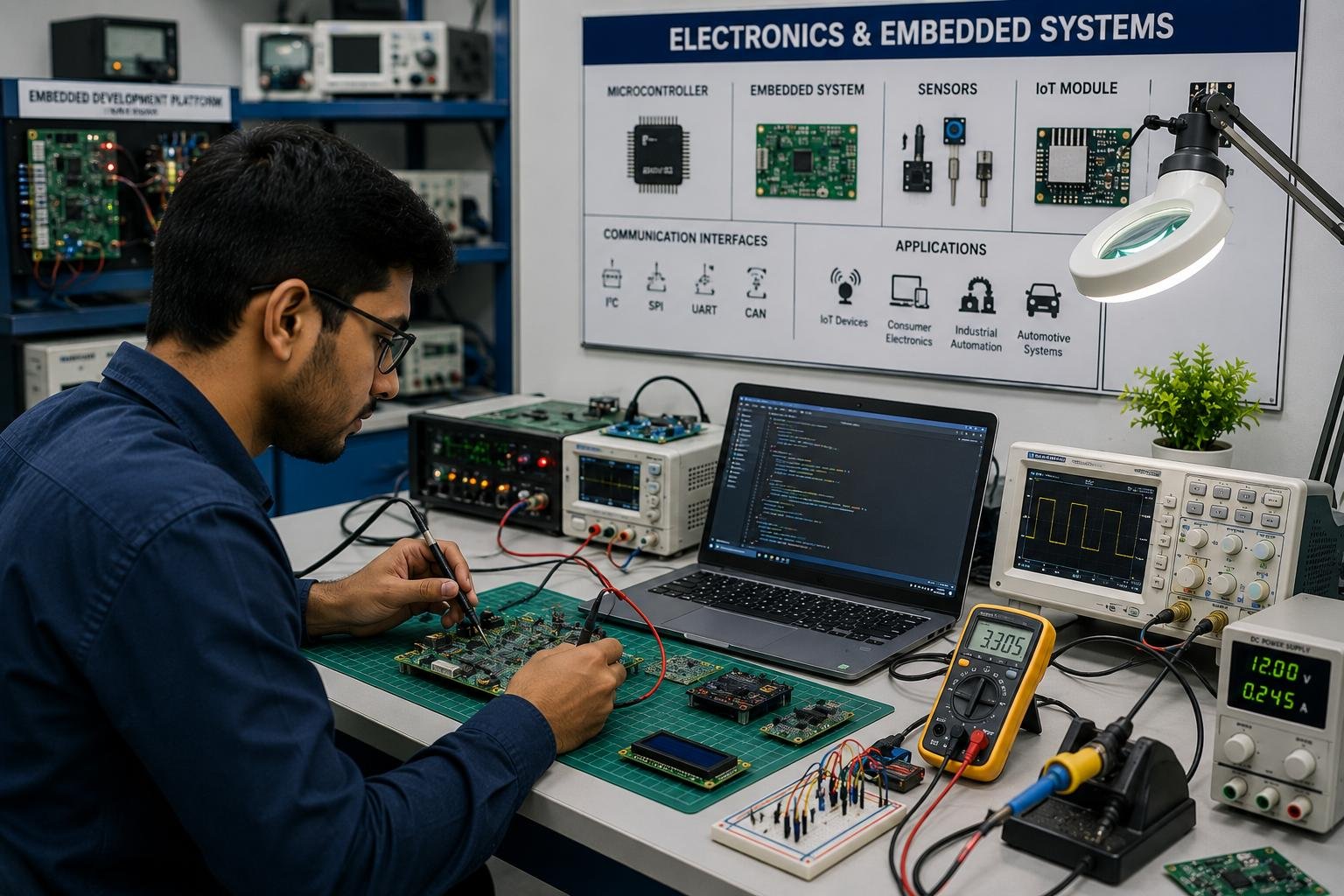
Embedded Systems & IoT Internship
Gain hands-on experience in Embedded Systems and IoT using microcontrollers, sen...
30 days
20 seats left
View Details
Internet of Things (IoT) Full-Stack Internship
Hands-on industry internship designing cloud-connected smart hardware devices wi...
30 days
20 seats left
View Details

STM32 Microcontroller & Bare-Metal Programming Internship
Learn STM32 microcontroller programming through hands-on bare-metal development ...
30 days
20 seats left
View Details